Monday, February 2, 2015

Unit 4 Review: Rotate? Or Nah?

Rotational Inertia & Tangential Velocity

Rotational Inertia is the willing an object has to turn. If something had a high rotational inertia, it's going to take more effort for it to rotate, and low rotational inertia will be a higher chance of rotating. To have a high rotational inertia, the mass of the object if spread out unevenly or far from the point of axis, like a hoola-hoop or volleyball. To have a small/low rotational inertia, mass has to be spread out evenly throughout the object and/or close to its centre axis, like a bowling ball and a meter stick with weights closer to the centre axis. 
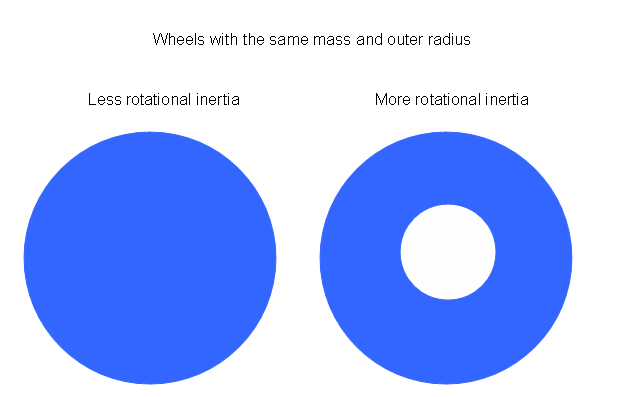

Rotational velocity is how fast the spot on a circular object is moving. Every spot on the object have equal rotational velocity because they travel the same circle in same amount of time. Tangential velocity is different from rotational velocity. The further out you go from the centre of the circle rotating, the faster you'll be going tangentially. This is because you are now traveling a greater distance in the same time, the middle little distance in same time.
This leads to the conservation of Angular Momentum:

Conservation of Angular Momentum


This conservation explains the certain angular acceleration of, lets say, an ice skater. When she brings her legs and arms in, she decreases her body's inertia.

rotational velocity x rotational inertia = rotational velocity x rotational inertia

Torque

Torque depends on two factors, lever arm and force. Torque is the willing an object is going to rotate. There is the objects clockwise and counter clockwise torques (for which way it will rotate). Ever hold a baseball bat on one finger and see it balances with more of the little side on one side compared to the big side. This is because of conservation of torque. The two sides don't weigh the same, they just have equal torques which make them balance. This is an example of the equation of conservation of torque:
force x leverarm=force x leverarm.

Centre of Gravity and Mass

Going back to the baseball bat, where your finger is, see how it's balancing there, that is where the centre of gravity of the bat is. The centre of gravity is where the force of gravity mostly affects an object. It is 99% of the time directly in the middle of the object. Centre of mass is the same thing of centre of gravity but can be changed. Let's say you are standing still, your centre of gravity is over your base of support which is your feet. Then you are given a large box to carry, you lean back, why? You are adding mass to a side of you so you balance out your centre of mass by keeping it over support. If it leaves support, you or the object will fall over. Objects tilting over and don't fall are objects who's centre of gravity is over support, just like the Leaning Tower of Pisa. 

Centripetal and Centrifugal "Forces"

Why is forces in quotes. This is because these aren't really forces. They are a description or example of a object being affected. Centripetal is when an object is being pulled/rotated back into the rotational of an object, like a cup on a string. The string is the centripetal force pulling the cup into the centre. Centrifugal is the opposite. Just remember they're not forces, just occurrences.


Friday, January 30, 2015

Finding The Mass of a Meter Stick Lab

We had a lab this week to find the actual mass of the meter stick.

First we had to do a demo and place the meter stick on the table unbalanced and label the forces + lever arms like so:


Then we had to balance the meter stick on the table to find the centre of gravity and again label the forces and lever arms:


Here we found out that the centre of gravity for the meter stick was exactly at 50cm.

Now we added the 100g weight to the end of the meter stick and watch it become unbalance. Here we labeled the torques, forces, and lever arms.


Plan:

The Plan to find this mass of the meter stick was pretty simple. You have to know the conservation of torque and angular momentum, which is Force x lever arm= F x lever arm.
  1. Convert the 100g weight into kg by multiplying by 1000. (We need kg to do the force equation)
  2. Find where the centre of gravity and mass was of the meter stick alone. (50cm)
  3. Convert the mass into force
  4. Add the weight to end of meter stick
  5. Balance the meter stick with the weight so it stays on the table
  6. Find the new centre of mass which is where the edge of the table read on the meter stick (70cm for me)
  7. Use the equation conservation of torque
  8. Find the force of the meter stick side
  9. Use w=mg to find mass of it in kg (150000)
  10. Divide by 1000 to get grams (150)

Results:

My plan that I planned above actually went great. The meter stick with the weight balanced on the table at 70cm and the lever arm for the weight was 30 (100-70 because 70cm was the centre of mass). The lever arm for the meter stick was 20cm. Then found the force of the weight which was mass*9.8 (gravity) and got 980000. So I plugged them into the equation (Torque of Meter stick: F*20cm=980000*30cm:torque of side-weight). The final result of the force for the meter stick was 1470000. Then converted back into kg, then into g using the before equations. I was 6 grams away from the actual mass of the meter stick which was 144g. This is a demonstration/example of how things are balanced, they have counter and clockwise torques on both sides of them that balance out each other in the equation with their lever arms and Forces.

Sunday, January 25, 2015

New Year - New Material

The beginning of this year we started off with some new things to learn and discuss about. We talked about torque and rotational inertia. Here are two videos that help explain them both:


In this torque video it explains the basis. Torque is based on two things: force and lever arm. Torque is, in basic terms, the force to turn/rotate an object, like a screw. Door stoppers also help explain this; the reason why we put them farther from the hinges is because the door stopper can only hold so much force, so it needs a bigger lever arm to proportion it.


In this video it shows two discs racing, one disc has mass farther from the centre axis and one with it closer. As you can see the one with the mass closer wins, this is a proof/example of rotational inertia. Rotational Inertia is how much an object wants to move/rotate with the mass closer or far from its centre axis. If mass is closer, then the rotational inertia is less, farther then bigger. If objects want to be rotated easier, then they would want their mass to be evenly spread out its body, which makes it have a low rotational inertia.

Sunday, December 7, 2014

Unit 3: FORCES

In Unit 3, we learned about forces. What happened to Newton? Well, his third law was a big part in this unit.

Newton's Third Law

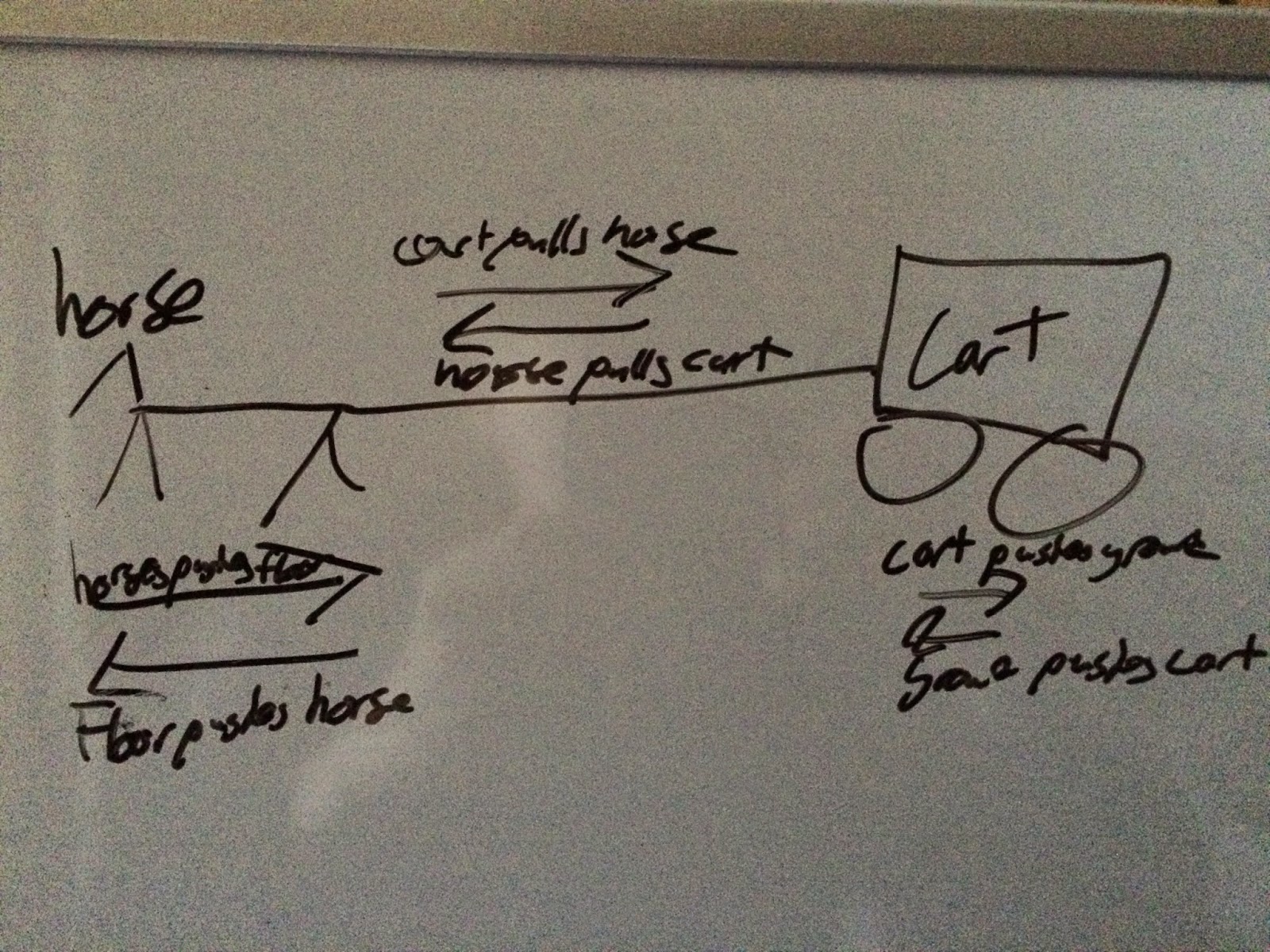
His third law states that every action caused upon an object, or is caused by an object, has an equal and opposite reaction. What does this mean? Well, when you are walking forward, you push the ground behind you; push is a type of force. This force and action has a reaction to it which is the ground pushes you forward. To have a real action and reaction pair, the force has to be the same between the same objects. In this action and reaction pair, the forces are equal, which means if you were showing a picture, the vectors will also be equal. Here is an example with a horse pulling a cart (Sorry for the bad writing):

As you can see, The vectors for the horse and ground using one another are similar to the size of the horse and cart pulling one another. This is because they're similar forces, but you see the cart and ground pushing vectors are smaller than both is because the cart isn't really causing itself to push the ground, it's being pulled by the horse, so less force itself. 

Perpendicular Forces

In the above, I wrote about how parallel forces are there and now what about what happens when you are in a boat sailing to cross a river thats flowing a certain speed. Let's say the river flows 5m/s down and the wind pushes you about 3m/s. Here is an example: 
Here, since the rive flows down 5m/s and you sail across 3 m/s, your boat will go at an angle 4m/s, until you hit the x. We know it's 4 because of our 3-4-5 right triangles. These forces and actions happen in everyday life such as boat in a river or a plane with wind pushing it.

Tides

In this unit, we also learned about tides. Tides happen everyday on Earth. We experience 4 tides a day, 2 high and 2 low. Each high and low tide are 6 hours apart from each other, so that means each high tide is 12 hours apart, same for low tides. What causes these tides is the force of pull from the moon. The moon pulls the water and Earth towards it, but the Earth fights back, kind of like tug of war. The formula/equation we use to show the force of gravity is F=G(m1m2/d^2). G is 7*10^24 (or near that).Since the Earth pulls back to stay in its orbital, it causes the tide bulge, which is the oval water shape. If the moon pulls the water closest to it/ the side of Earth facing it with let's say 5N, then the other water side is being pulled with -5N because of this tug of war. Negative is a force in the other direction. This means that if theres a high or low tide on one side of the earth, then it's the same on the opposite side. Tides are caused by the phases of the moon and sun. When the sun and moon line up with he earth in somewhat a straight line, those are called spring tides, when the tides are higher then usual. When the moon is on one side of the earth and the sun is on the other side, 90 degrees, this forms neap tides.

Momentum 

Last thing we learned about was momentum. Momentum in physics variables is p, and p=mass(velocity) [p=mv] measured in kgm/s. We learned that when an object that's moving hits another object thats at rest, gives/passes its momentum through it and moves/sticks together and moves together at a new velocity. Same momentum? Yes, because the momentum before is equal to the momentum after. Also, if there was a change in momentum on an object, to find this change you would use the final momentum minus the initial/starting one. This leads to the impulse on objects too. Impulse is the variable J. J= the change in momentum and it also equals force times the change in time. This is measured in Ns. Law of conservation momentum is showing the relation momentum and impulse. All of this helps us figure out why gymnast use matts instead of the hard floor to land on, the matts slow them down (longer time), so small force, and small force causes less injury. This also shows us why we don't have rubber bumpers on cars, land with bent knees, and landing in snow can help us survive off a mountain.


Sunday, November 16, 2014

How Tides Work


Here I have found a video/resource to explain tides in an animated way.
Tides happen everyday on Earth. We experience 4 tides a day, 2 high and 2 low. Each high and low tide are 6 hours apart from each other, so that means each high tide is 12 hours apart, same for low tides. What causes these tides is the force of pull from the moon. The moon pulls the water and Earth towards it, but the Earth fights back, kind of like tug of war. Since the Earth pulls back to stay in its orbital, it causes the tide bulge, which is the oval water shape in the video. If the moon pulls the water closest to it/ the side of Earth facing it with let's say 5N, then the other water side is being pulled with -5N because of this tug of war. Negative is a force in the other direction. This means that if theres a high or low tide on one side of the earth, then it's the same on the opposite side.
Tides are caused by the phases of the moon and sun. When the sun and moon line up with he earth in somewhat a straight line, those are called spring tides, when the tides are higher then usual. when the moon is on one side of the earth and the sun is on the other side, 90 degrees, this forms neap tides.

http://www.tide-forecast.com/locations/Grand-Cayman-Cayman-Islands/tides/latest
Here are the tides of the Cayman Islands, the main island, Grand Cayman. Grand Cayman experienced high tide, going down to low tide when I wrote this. These tides/this beach is going to experience spring tides in the next few days, since it's going to be a new moon. So they are getting ready for those high and low tides.

Thursday, November 6, 2014

Newton's 3rd Law

In this video, this guy explains Newton's third law. This 3rd law is every object that has an action also has a reaction. This means if the earth pulls me, I pull the earth too. Another example is an apple in my hand. I push the apple up and it pushes my hand down.
This video the guy explain more examples of how it's all connected. It's a really great video to go by and helps if you ever need help in this area of Physics. He explains the law, shows examples of most-all action and reaction pairs, with their vectors. Vectors are the arrows you see in the examples that show which way or how much of the force is happening in a certain direction. If you need more help with the 3rd law just watch this video!

Sunday, October 26, 2014

Newton's Second Law Review (UNIT 2 REVIEW)

In Unit 2, I learned about Newton's second law. This law talks about the relations with force, acceleration, and mass. Acceleration has a verse relationship with force, but an inversely relationship with mass. If force is increased then acceleration increases, if mass increases then acceleration decreases, and vice-versa for both. Many people get this confused with the actual definition of acceleration, a=change in velocity over time, these relations are just proofs for the second law.
 I also learned about free fall, free falling at an angle, free falling when thrown up, and skydiving fall (fall with air resistance). Let's start with Free Fall basics.

Free Falling

In Free Fall there is no resistance. What does that mean? Well, no air resistance means like you're in space, where if you moving/falling nothing (no air) is being pushed against you, this means you fall at a constant acceleration.
For the constant acceleration of free fall, we use a=9.8m/s^2. Most of the times, like in labs we used a=10m/s^2. So every second, you increase your speed by 10m/s (9.8).
Last bit to remember mostly about free fall is weight/mass does not matter. If you had no air and dropped a feather and a brick, they would hit the ground at the exact same time.

Free Falling @ an Angle

So, have you ever heard about a plane that needs to drop a package, or you jumping off a cliff. Well, where do you/the package land, how long are you/the package in the air for. We can calculate all of this using d=1/2gt^2 and d=vt.
To find the time, use the height (vertical) distance to see how long it would take you to get to the ground. Let's say you were on a 250m high cliff and wanted to figure out how long it will take you to hit the ground, if you ran off at a constant speed of 5m/s. d=1/2gt^2 is the equation we will use, so 250=1/210(t^2), 250/5=t^2, 50=t^2, t=7.07 seconds.
Now that you have seconds you can see how far you will go too. d=vt is the equation we use for horizontal distance. Plug it in (d=5(7.07)), you will go 35.35 meters. To find the actual velocity you are going at any second, use a triangle, and see how to do the other things like so:


Special triangles are the right triangles in which we use the 345, and a^2+b^2=c^2

Free Falling When Thrown Up

Now we have a ball thats thrown up. You can see how, since there is still no air resistance, the ball will decrease in acceleration up by 10m/s^2 and increase on its way back down. 


To find the height, use the d=1/2gt^2, to find the total height of its highest part. Once you find this, you can use the same equation to find how high the ball is after 3s, 5s, etc.. Just use the same equation and then subtract it from the total height.


Also to do with an angle thrown, here is another video made by my friends to explain it better: 


Falling (Sky-Diving)